
The short answer: three years for most receipts
For most people, the answer to how long to keep receipts for taxes is three years from the date you filed the return they support. That's the IRS's standard window for reviewing a return or for you to claim a refund. A return filed early counts as filed on the due date, so receipts behind your 2026 return, filed in April 2027, can usually go after April 2030. The IRS lays out every case on its page about how long to keep records, and the list below sums it up.
The IRS time limits that apply to your receipts
3 years
For most returns and most receipts, counted from the date you filed.
3 years, or 2 after paying
If you claim a refund after filing, keep records 3 years from filing or 2 years from paying the tax, whichever is later.
6 years
If income you should have reported, and didn't, is more than 25% of the income on your return.
7 years
If you claim a loss from worthless securities or a bad debt deduction.
4 years
For employment tax records, if you have employees.
Indefinitely
If you didn't file a return, or filed a fraudulent one.
Receipts for a home or big purchases follow a longer clock
Receipts tied to property, like a home, a rental, or equipment you depreciate for a business, follow a different rule. The IRS says to keep them until the three-year window closes for the year you sell or get rid of the property. Say a freelance designer buys a laptop for work and deducts it over several years. That receipt matters for as long as the laptop is on the books, plus three years after the return for the year it's sold or retired. Kitchen remodels and new roofs work the same way, because they can lower the taxable gain when you sell the house.
Which receipts are worth keeping for taxes?
Before you decide how long to keep receipts for taxes, it helps to know which ones have a tax job at all. The ones that matter back up something on your return: a business expense, a deduction, or the cost of something you might sell later. If you take the standard deduction and don't run a business, very few everyday receipts matter for taxes. If you itemize, own a business, or work for yourself, many more do, and your tax preparer can tell you exactly which ones to hold on to.
Receipts that usually matter
Business expenses
Supplies, equipment, mileage, travel, and meals you deduct.
Itemized deductions
Charitable donations and medical expenses, if you itemize.
Home and property
The purchase, improvements, and anything that changes your cost basis.
Health savings accounts
Receipts that show an HSA withdrawal paid for a qualified expense.
Should I keep grocery receipts for taxes?
Usually not. For most households, groceries aren't deductible, so the receipts have no tax job. The exceptions are business ones: a caterer buying ingredients, or a business owner buying snacks for the office, may deduct those costs and should keep the receipts. So if you're asking whether you should keep grocery receipts for taxes, the answer depends on whether the purchase was for your household or your business. For business travel, gifts, and car expenses, the IRS doesn't require a receipt for a cost under $75 (other than lodging), but you still need a record of what it was for, as IRS Publication 463 explains.
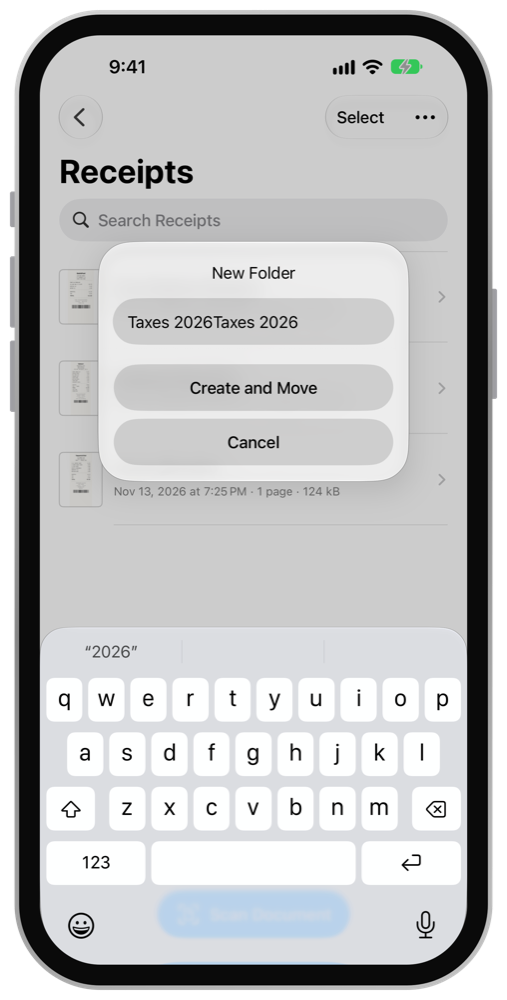
Folders when you want them
One tap, one folder for each tax year.
How to keep receipts for years without a shoebox
Three to seven years is a long time for a paper receipt. Most are printed on thermal paper that fades, so a receipt you need in year three may be unreadable by then. If you're wondering how long to keep receipts for taxes on paper, the honest answer is longer than the paper lasts. Scanning them while they're fresh solves that, and our guide on how to scan receipts on your iPhone walks through it step by step. Once they're scanned, how long should you keep receipts stops being a storage problem: a thousand scans take up no room at all.
A simple system works best. Make one folder per tax year, like Taxes 2026, and drop each receipt in as you scan it. At tax time, everything for that year is in one place, and Setrik Scan's receipt scanner search finds any receipt by the store, an item, or the amount printed on it. Imagine a family with a home office: the printer ink, the desk chair, and the internet bill all land in that year's folder, ready for the tax preparer. Setrik Scan keeps every scan on your iPhone and never sends it to us, to Apple, or to anyone, which is how tax papers should be kept.
The bottom line
So, how long to keep receipts for taxes?
Three years after you file covers most receipts for most people. Keep them six or seven years in the special cases above, keep property receipts until three years after the year you sell, and keep everything if a return was never filed. Your insurance company or lender may want some records longer than the IRS does, so check before you toss anything they might ask for. The easy way to never worry about it is to scan each receipt the day you get it and keep it in a folder for that tax year.
Find any receipt by a word on it
Setrik Scan reads every receipt you scan, so search finds it by the store, an item, or the total.
See how Search works